


2024 Provide Updated ACAMS CAMS-FCI Dumps as Practice Test and PDF
CAMS-FCI Dumps are Available for Instant Access
NEW QUESTION # 29
The investigative department of a financial institution (Fl) receives an internal escalation notice from the remittance department for a SWIFT message requesting a refund due to potential fraud. The notice indicates that a total of three international incoming remittances were transferred to a corporate customer from Country A, in the amount of approximately 5 million EUR for each. The first two incoming remittances had been exchanged into currency B and transferred out to Country B a few days ago. The third incoming remittance has been held by the remittance department.
As noted from the KYC profile, the corporate customer is working in the wood industry. with the last account review completed 3 months ago. Since the account's opening. there has been no history of a large amount of funds flowing through the account. The investigator conducts an Internet search and finds that the remitter is a food beverage company.
The same morning, the investigator receives a call from a financial intelligence unit (FIU) inquiring about the same incident. The FIU states that it will issue a warrant to freeze the account on the same day.
After further review, the decision is made that transactions appear suspicious. Which are the next steps the investigator should take? (Select Two.)
- A. Gather all the information that would be useful for law enforcement (LE) and recommend filing a SAR/STR
- B. Contact local LE and advise them of the investigation details to help speed up the investigation and prosecution.
- C. Close the customer's accounts since the FIU is issuing a warrant to freeze the funds.
- D. Close the investigation as the FIU is already on this matter, and they will inform LE if needed.
- E. Provide additional information to the LE upon receiving a formal request.
Answer: A,E
Explanation:
Explanation
The correct answer is C and E.
The investigator should provide additional information to the LE upon receiving a formal request, and gather all the information that would be useful for LE and recommend filing a SAR/STR. These steps are consistent with the best practices of conducting financial crime investigations and reporting suspicious activity. The investigator should not close the customer's accounts or the investigation, as this may interfere with the ongoing LE inquiry and violate the FI's policies and procedures. The investigator should also not contact local LE directly, as this may compromise the confidentiality of the investigation and the FIU's authority. References:
Advanced CAMS-FCI Study Guide, Chapter 4: Reporting Suspicious Activity, pages 40-411 Advanced CAMS-FCI Study Guide, Chapter 5: Governance of an AFC Investigations Unit, pages
48-491
Advanced CAMS-FCI Certification | ACAMS
NEW QUESTION # 30
During a review, an analyst notices discrepancies between a customer's nature of business listed on the business registry and what was stated on the customers application. The analyst should:
- A. clarify discrepancies noted in the customer's declared profile given the downstream impact on the risk assessment.
- B. accept discrepancies in the information given the onboarding team did not flag any issue.
- C. close the review as there is no adverse news in the public domain.
- D. review all documents for whether certified true copies are submitted.
Answer: A
Explanation:
Explanation
The analyst should clarify discrepancies noted in the customer's declared profile given the downstream impact on the risk assessment. This is because discrepancies between the customer's nature of business and the information on the business registry may indicate that the customer is not operating a legitimate business or is trying to conceal its true activities. The analyst should verify the customer's identity, source of funds, and purpose of transactions to ensure that the customer's risk profile is accurate and consistent with the Fl's risk appetite.
References: Leading Complex Investigations Certificate, Module 2, page 9.
NEW QUESTION # 31
A national financial intelligence unit (FIU) is undertaking the country risk assessment for the financing of the proliferation of weapons of mass destruction (WMD). The evaluation involves determining the exposure that financial institutions (FIs) have to operations that evade sanctions. Which should be performed by the FIU to assess proliferation financing risk? (Select Two.)
- A. Cross-reference the databases of international commerce/logistics transactions between the country and WMD proliferation sanctioned states with the corresponding international financial operations of those transactions.
- B. Compare the international finance operations with national PEP lists to determine if the systems used by FIs are properly calibrated to detect WMD proliferation financing.
- C. Prepare new regulations that increase fines for FIs that allow financial operations on behalf of WMD proliferation sanctioned states.
- D. Evaluate a sample of the amount of false-positive and false-negative alerts that FIs have regarding proliferation sanctions evasion to determine root causes of non-detection.
- E. Analyze the domestic financial operations that are above the reporting threshold and have similar names to high-level officials of WMD proliferation sanctioned states.
Answer: A,D
Explanation:
Explanation
The FIU should cross-reference the databases of international commerce/logistics transactions between the country and WMD proliferation sanctioned states with the corresponding international financial operations of those transactions, as this would help identify any discrepancies or anomalies that could indicate sanctions evasion. The FIU should also evaluate a sample of the amount of false-positive and false-negative alerts that FIs have regarding proliferation sanctions evasion to determine root causes of non-detection, such as inadequate screening systems, lack of training, or human error. These actions would help the FIU assess the proliferation financing risk and provide feedback and guidance to FIs on how to improve their detection and prevention capabilities.
References: Advanced CAMS-FCI Study Guide, page 32-33; [FATF Guidance on Counter Proliferation Financing], page 15-16.
NEW QUESTION # 32
In which case should an investigator avoid escalating a suspicious event to the chief compliance officer and pursue other channels?
- A. A trade entity engages in complex trade deals involving numerous third-party intermediaries in incongruent lines of business.
- B. A close family member of the chief compliance officer is the beneficiary of a cross-border transfer.
- C. An individual involved in a large sum transaction is a foreign PEP.
- D. The transaction chain is likely connected to a known member of a terrorist organization.
Answer: B
Explanation:
Explanation
An investigator should avoid escalating a suspicious event to the chief compliance officer if there is a potential conflict of interest, such as when a close family member of the officer is involved in the transaction. In such a case, the investigator should pursue other channels, such as reporting to a higher authority or an independent committee. The other options do not present a conflict of interest and should be escalated to the chief compliance officer as part of the normal procedure.
References: Advanced CAMS-FCI Certification Handbook, page 18.
NEW QUESTION # 33
A financial institution <FI> might use which option as intelligence to file a SAR/STR?
- A. The Fl discovers a large number of securities transactions that appear to be related to day trading.
- B. The Fl is unable to obtain evidence of required licensing or registration despite suspicion of money transmitting.
- C. A customer makes several deposits in one month that appear to exceed their expected monthly income.
- D. A customer receives a large, one-time wire from a law firm.
Answer: B
Explanation:
Explanation
The correct answer is C because the FI is unable to obtain evidence of required licensing or registration despite suspicion of money transmitting, which is a red flag for money laundering and a violation of federal and state laws. Option A is incorrect because making several deposits in one month that appear to exceed their expected monthly income might not be indicative of suspicious activity, depending on the customer's profile and source of funds. Option B is incorrect because receiving a large, one-time wire from a law firm might not be indicative of suspicious activity, depending on the customer's relationship with the law firm and the purpose of the wire. Option D is incorrect because discovering a large number of securities transactions that appear to be related to day trading might not be indicative of suspicious activity, depending on the customer's investment strategy and risk tolerance.
References: Money transmitter - Wikipedia; The Quick Guide To Money Transmitter Licenses - Surety Bond Insider; Financial Crime Typologies - Intermediate Certificate, Module 3.
NEW QUESTION # 34
Which reputations risk consequence could a financial entity face for violating AML laws?
- A. Seizure of assets
- B. Monetary penalties
- C. Loss of high-profile customers
- D. Increased audit costs to monitor behavior
Answer: B
Explanation:
Explanation
According to the Certified Anti-Money Laundering Specialist (CAMS) Manual [1], 6th edition, financial entities that violate Anti-Money Laundering (AML) laws can face several reputational risks such as loss of high-profile customers, seizure of assets, increased audit costs to monitor behavior, and monetary penalties.
For example, the US Treasury's Financial Crimes Enforcement Network (FinCEN) imposes civil money penalties on "persons who willfully violate, attempt to violate, conspire to violate, or cause any violation of any provision of the Bank Secrecy Act or its implementing regulations." (CAMS Manual, 6th edition, page
26).
NEW QUESTION # 35
CLIENT INFORMATION FORM Client Name: ABC Tech Corp Client I.D. Number: 08125 Name: ABC Tech Corp Registered Address: Mumbai, India Work Address: Mumbai. India Cell Phone: ***"- Alt Phone:
Email: ********
Client Profile Information:
Sector: Financial
Engaged in business from (date): 02 Jan 2020
Sub-sector: Software-Cryptocurrency Exchange
Expected Annual Transaction Amount: 125.000 USD
Payment Nature: Transfer received from client's fund
Received from: Clients
Received for: Sale of digital assets
The client identified themselves as "Cryptocurrency Exchange" Client has submitted the limited liability partnership deed. However, the bank's auditing team is unable to identify the client's exact business profile as the cryptocurrency exchange specified by the client as their major business awaits clearance from the country's regulator. The client has submitted documents/communications exchanged with the regulator and has cited the lack of governing laws in the country of their operation as the reason for the delay.
Investigators determine the ultimate beneficial owner of ABC Tech Corp is a high-net-worth client. The client owns a real estate agency left to her when her spouse died. The spouse provided seed capital for ABC Tech Corp through a direct 1,000.000 Great British Pound (GBP) deposit.
What additional information would trigger filing a SAR/STR?
- A. The client's current net asset value is 8 million GBP, of which 7.5 million GBP was derived from the inheritance.
- B. An open-source search revealed that the client's spouse was a PEP.
- C. The funds for the seed capital were in the form of 50 cashier's checks of 10,000 GBP each and 50 money orders of 10,000 GBP.
- D. The client's spouse's source of wealth was a salary of 250,000 GBP per annum for the past 4 years and rental of properties of 150,000 GBP per annum for the past 6 years.
Answer: C
Explanation:
Explanation
The additional information that would trigger filing a SAR/STR is the fact that the funds for the seed capital were in the form of 50 cashier's checks of 10,000 GBP each and 50 money orders of 10,000 GBP. This is because this indicates a possible attempt to avoid the reporting threshold of 10,000 GBP for cash transactions, which is a common money laundering technique known as structuring or smurfing12. The other options are not necessarily suspicious, as they do not involve cash transactions or indicate any illicit source of funds. The fact that the client's spouse was a PEP does not automatically make the transaction suspicious unless there are other red flags or risk factors associated with the PEP34 References: 1: Money Laundering Techniques 2: Structuring 3: Politically exposed person 4: PEP Definition
& Meaning - Merriam-Webster
NEW QUESTION # 36
An analyst reviews an alert for high volume Automated Clearing House (ACH) activity in an account. The analyst's initial research finds the account is for a commercial daycare account that receives high volumes of large government-funded ACH transactions to support the programs. The account activity consists of checks (cheques) made payable to individual names in varying dollar amounts. One check indicates rent to another business.
An Internet search finds that the daycare company owner has previous government-issued violations for safety and classroom size needs, such as not having enough chairs and tables per enrollee. These violations were issued to a different daycare name.
Simultaneous to this investigation, another analyst sends an email about negative news articles referencing local child/adult daycare companies misusing governmental grants. This prompts the financial institution (Fl) to search all businesses for names containing 'daycare' or *care'. Text searches return a number of facilities as customers at the Fl and detects that three of these businesses have a similar transaction flow of high volume government ACH funding with little to no daycare expenses.
Which red flags would be an indicator that activity is connected to a corruption/bribery typology? (Select Two.)
- A. Checks issued to an unrelated entity referencing "rent" and "utilities" in the memos
- B. Large checks issued to various individuals with the memos noting "gift", "thank you", "favor"
- C. Multiple daycare locations with no active business operations or related account activity
- D. The same beneficial owner owning several daycare centers in different locations
- E. Negative news found on the customer related to government-issued violations for safety
Answer: B,E
Explanation:
Explanation
The red flags that would be an indicator that activity is connected to a corruption/bribery typology are large checks issued to various individuals with the memos noting "gift", "thank you", "favor" (A) and negative news found on the customer related to government-issued violations for safety (B). These red flags suggest that the customer is involved in paying or receiving bribes or kickbacks to or from government officials or other parties in exchange for favorable treatment or contracts. These red flags are consistent with some of the indicators of corruption/bribery identified by ACAMS1, such as:
Payments made to or from third parties that are not directly related to the business Payments made to or from high-risk jurisdictions or sectors Payments made with vague or incomplete descriptions or justifications Negative news or reputation of the customer or its associates The other options are not as relevant or indicative of corruption/bribery as options A and B. Checks issued to an unrelated entity referencing "rent" and "utilities" in the memos could be a legitimate business expense or a sign of other types of fraud or money laundering, such as tax evasion or shell company schemes. Multiple daycare locations with no active business operations or related account activity (D) could also be a sign of other types of fraud or money laundering, such as embezzlement or front company schemes. The same beneficial owner owning several daycare centers in different locations (E) could be a normal or legitimate business practice, depending on the size, location, and profitability of the centers.
NEW QUESTION # 37
An investigator is reviewing an alert for unusual activity. System scanning detected a text string within a company customer's account transactions that indicates the account may have been used for a drug or drug paraphernalia purchase Based on the KYC profile, the investigator determines the customer's company name and business type are marketed as a gardening supplies company. The investigator reviews the account activity and notes an online purchase transaction that leads the investigator to a website that sells various strains of marijuana. Additional account review detects cash deposits into the account at the branch teller lines, so the investigator reaches out to the teller staff regarding the transactions. The teller staff member reports that the business customers have frequently deposited cash in lower amounts. The teller, without prompting, adds that one of the transactors would occasionally smell of a distinct scent of marijuana smoke.
Which are the best next steps for the investigator to take? (Select Three.)
- A. Review the customer's transaction history.
- B. Research other customer accounts for transactions to the same website.
E Conduct adverse media and open-source searches on the customer's background. - C. Identify if the customer has opened accounts in an urban city area.
- D. Request information from the internet service provider who hosts the website.
- E. Check internal KYC information.
Answer: A,C,E
Explanation:
Explanation
The best next steps for the investigator to take are:
A: Review the customer's transaction history. This can help the investigator identify any patterns or anomalies in the customer's account activity, such as changes in transaction volume, frequency, amount, source, destination, purpose, etc. The investigator can also compare the customer's transaction history with their KYC profile and risk rating to assess if there are any discrepancies or inconsistencies.
C: Check internal KYC information. This can help the investigator verify the customer's identity, business nature, ownership structure, expected activity, source of funds, etc. The investigator can also update or enhance the customer's KYC information based on any new or relevant information obtained from other sources.
E:Conduct adverse media and open-source searches on the customer's background. This can help the investigator find out if there is any negative or adverse information about the customer in public data sources, such as news articles, social media posts, blogs, forums, etc. Adverse media and open-source searches can also provide additional context and insight into the customer's reputation, behavior, associations, etc. The other options are incorrect because:
B: Request information from the internet service provider who hosts the website is not feasible, as it may require a legal process or a court order to obtain such information. Moreover, the internet service provider may not have or disclose any useful information about the website or its owner.
D: Research other customer accounts for transactions to the same website is not relevant, as it may not provide any meaningful information about the customer under investigation. Furthermore, it may violate the privacy and confidentiality of other customers who are not related to the investigation.
F: Identify if the customer has opened accounts in an urban city area is not helpful, as it may not have any bearing on the customer's involvement in a drug or drug paraphernalia purchase. Additionally, it may not be possible to access or verify such information without the customer's consent or authorization.
References:
Advanced CAMS-FCI Certification | ACAMS, Section 2: Investigating Financial Crimes, page 11 Leading Complex Investigations Certificate | ACAMS, Module 3: Conducting Research and Analysis, page 6 Adverse Media Screening - Using AI to Mitigate Risk Legal requirements for adverse media screening - Thomson Reuters Electronic client due diligence | Ethics helpsheets | ICAEW
6AMLD & FATF: Where Adverse Media Screening Fits In
Free Adverse Media Check | NameScan
NEW QUESTION # 38
Which statement most accurately characterizes the methods used by transnational criminal organizations?
- A. They are unlikely to associate with known terrorist organizations due to the reputational risks.
- B. They routinely engage in many different types of criminal activities as long as they think it will benefit them.
- C. They see each other as competitors and rarely cooperate.
- D. They are likely to specialize in one particular method and continue to refine that method to escape detection.
Answer: B
Explanation:
Explanation
The statement that most accurately characterizes the methods used by transnational criminal organizations is that they routinely engage in many different types of criminal activities as long as they think it will benefit them . This is because transnational criminal organizations are flexible and adaptable, and they exploit opportunities and vulnerabilities in different markets and jurisdictions. According to ACAMS2, "Transnational criminal organizations are involved in a wide range of illicit activities, such as drug trafficking, human trafficking, arms trafficking, money laundering, cybercrime, environmental crime, fraud, corruption, and terrorism" (p. 3). They also "operate across borders and regions, using complex networks and structures to evade detection and prosecution" (p. 3).
The other statements are not as accurate or comprehensive as option C. Transnational criminal organizations are unlikely to associate with known terrorist organizations due to the reputational risks (A) is false, as transnational criminal organizations may collaborate or cooperate with terrorist organizations for mutual benefit or convenience, such as sharing resources, routes, or contacts. Transnational criminal organizations are likely to specialize in one particular method and continue to refine that method to escape detection (B) is false, as transnational criminal organizations may diversify or change their methods depending on the circumstances or opportunities, such as shifting products, markets, or modus operandi. Transnational criminal organizations see each other as competitors and rarely cooperate (D) is false, as transnational criminal organizations may form alliances or partnerships with other criminal groups for strategic or tactical reasons, such as sharing information, expertise, or influence.
NEW QUESTION # 39
A financial institution (Fl) has considered the available relevant factors in a transaction and has determined it will file a SAR^STR. Which is needed to support the contents of the report to the financial intelligence unit?
- A. Low evidentiary threshold about the suspicious activity
- B. Enough circumstantial evidence about the suspicious activity for a criminal proceeding
- C. No factual description of the suspicious activity
- D. Definitive proof that suspicious activity occurred
Answer: A
Explanation:
Explanation
A SAR/STR does not require definitive proof or enough circumstantial evidence of suspicious activity, as these are high evidentiary thresholds that may be difficult or impossible to obtain by the FI. A SAR/STR should include a factual description of the suspicious activity, as this is essential for the FIU to analyze and disseminate the information. A low evidentiary threshold means that the FI has reasonable grounds to suspect that the activity is related to money laundering, terrorism financing, or other financial crimes, based on the available relevant factors. This is the main criterion for filing a SAR/STR.
References: Advanced CAMS-FCI Certification | ACAMS, Suspicious activity report - Wikipedia, Suspicious Transaction Report (STR) / Suspicious Activity Report (SAR ...
NEW QUESTION # 40
An investigator receives an alert documenting a series of transactions. A limited liability corporation (LLC) wired 59.000.000 USD to an overseas account associated with a state-run oil company. A second account associated with the state-run oil company wired 600,000,000 USD to the LLC. The LLC then wired money to other accounts, a money brokerage firm, and real estate purchases.
The investigator initiated an enhanced KYC investigation on the LLC. The financial institution opened the LLC account a couple weeks prior to the series of transactions. The names associated with the LLC had changed multiple times since the account opened. A search of those names revealed relations with multiple LLCs. Public records about the LLCs did not show any identifiable business activities.
Open-source research identified mixed reports about the brokerage firm. The firm indicated it purchased mutual funds for its clients and dispensed returns to clients. Media reports claimed the firm laundered money by holding money for a fee before returning it to investors.
What is the total suspicious transaction amount that the investigator should report?
- A. 59,000,000 USD
- B. 600,000,000 USD
- C. 541.000,000 USD
- D. 659,000,000 USD
Answer: D
Explanation:
Explanation
The total suspicious transaction amount that the investigator should report is 659,000,000 USD. This is the sum of the two transactions involving the LLC and the state-run oil company, which are 59,000,000 USD and
600,000,000 USD respectively. The other transactions that the LLC made to other accounts, a money brokerage firm, and real estate purchases are not relevant to the question, as they are not part of the series of transactions that triggered the alert.
References: Advanced CAMS-FCI Certification | ACAMS
NEW QUESTION # 41
Potential indicators of money laundering associated with Trust and Company Service Providers include:
(Select Two.)
- A. generation of rental income to legitimize illicit funds.
- B. frequent deposits to or withdrawals from bank accounts.
- C. multi-jurisdictional wire transfers with no legal purpose.
- D. structuring cash deposits into third party accounts.
- E. use of legal persons in jurisdictions with strict secrecy laws.
Answer: C,E
Explanation:
Explanation
This is stated in the Certified Anti-Money Laundering Specialist (the 6th edition) manual on page 595, which states: "Potential indicators of money laundering associated with Trust and Company Service Providers include the use of legal persons in jurisdictions with strict secrecy laws, structuring cash deposits into third party accounts, multi-jurisdictional wire transfers with no legal purpose, and frequent deposits to or withdrawals from bank accounts."
NEW QUESTION # 42 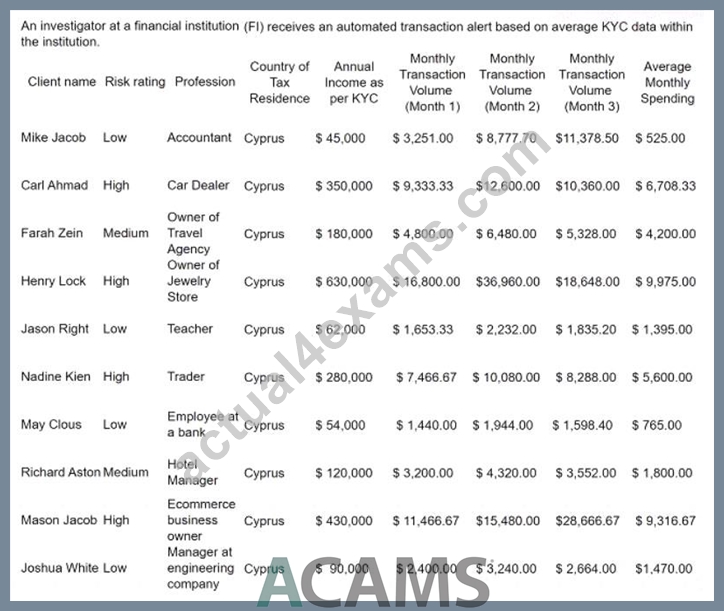
In a review of the account activity associated with Nadine Kien, an investigator observes a large number of small- to medium-size deposits from numerous individuals from several different global regions. The money is then transferred to a numbered company. Which is the next best course of action for the investigator?
- A. Recommend the account for exit due to frequent global transactions.
- B. File a SAR/STR on the account activity in relation to a potential funnel account.
- C. No further action is required as the customer is already rated at high-risk and the monthly spending is within expectations.
- D. Complete the monthly review and note the activity for next month's review.
Answer: B
Explanation:
Explanation
The next best course of action for the investigator is to file a SAR/STR on the account activity in relation to a potential funnel account. This is because a funnel account is a type of money laundering scheme that involves depositing funds from multiple sources into a single account, and then transferring them to another account, often in a different jurisdiction. A funnel account can be used to conceal the origin, ownership, and destination of illicit funds, and to evade currency transaction reporting requirements. The investigator should report the suspicious activity to the relevant authorities and document the findings and actions taken. The other options are incorrect because:
A: Completing the monthly review and noting the activity for next month's review is not sufficient, as it delays the reporting of a possible money laundering scheme and exposes the financial institution to regulatory and reputational risks.
C: Recommending the account for exit due to frequent global transactions is not appropriate, as it does not address the underlying issue of potential money laundering and may alert the customer of the investigation.
D: No further action is required as the customer is already rated at high-risk and the monthly spending is within expectations is not acceptable, as it ignores the red flags of a funnel account and fails to comply with the anti-money laundering obligations of the financial institution.
References:
Advanced CAMS-FCI Certification | ACAMS, Section 2: Investigating Financial Crimes, page 9 Leading Complex Investigations Certificate | ACAMS, Module 2: Identifying Red Flags, page 5
NEW QUESTION # 43
Which scenarios are common to money laundering through online marketplaces and trade-based money laundering? (Select Two.)
- A. Over-valuation of the stated price of goods
- B. No evidence of delivery of goods or shipping expenses
- C. Use of multiple freight forwarding or export companies
- D. Frequent conversion of foreign currency
- E. Use of fraudulent letters of credit
Answer: A,B
Explanation:
Explanation
Money laundering through online marketplaces and trade-based money laundering both involve the manipulation of the value or quantity of goods to disguise the illicit origin of funds. Over-valuation of the stated price of goods and no evidence of delivery of goods or shipping expenses are two common indicators of such schemes. The other options are not specific to these methods of money laundering.
References: Advanced CAMS-FCI Study Guide, page 29-30.
NEW QUESTION # 44
SAR/STR NARRATIVE
A SAR/STR has been submitted on five transactions conducted on the correspondent banking relationship with ABC Bank.
Client Information:
Remitter information: DEF Oil Resource Ltd. is the oldest member of the DEF Group. It was founded in 1977 as a general trading business with a primary focus on exports from Africa and North America. The group has business activities that span the entire energy value chain. Their core field of endeavor is centered within the oil and gas industry and its associated sub-sectors.
Beneficiary Information:
As per the response received from ABC Bank, it was determined that the beneficiaries are related to DEF Oil Resource Ltd. These were created by DEF Oil Resource Ltd. to purchase property in a foreign country on behalf of their senior management as part of a bonus scheme. The purpose behind this payment was for purchase of property in another country.
Payment Reference:
ABCXXXXX31PZFG2H
ABCXXXXXX51PQGEH
ABCXXXXXX214QWVG
ABCXXXXXX41PSXA2
ABCXXXXXX815QWS3
Concerns:
* We are unsure about the country of incorporation of the beneficiaries.
* We are concerned about the transactional activity since the payment made towards entities (conducted on behalf of individuals) appears to be possible tax evasion.
* There appears to be an attempt to conceal the identity of individuals (senior management), which again raises concerns about the source of funds.
* Referring to the response received from ABC Bank, we are unclear about the ultimate beneficiary of funds.
* The remitter is involved in a high-risk business, (i.e., oil and crude products trading), and the beneficiary is involved in a real estate business which again poses a higher risk.
The monitoring system of the correspondent institution flags the transaction as suspicious activity. The correspondent bank needs to send a request for information to the respondent bank. Which elements should be included in the request? (Select Three.)
- A. Details of DEF Oil Resource Ltd parent company and the name(s) of the beneficial owner(s)
- B. The account profile of the customer and their KYC data
- C. The last 6 months of transactional history
- D. The contract pertaining to the purchase of property in another country
- E. The respondent bank's customer's senior management bonus plan
- F. Full transaction history of the correspondent bank's customer
Answer: A,B,D
Explanation:
Explanation
The request for information should include the following elements:
Details of DEF Oil Resource Ltd parent company and the name(s) of the beneficial owner(s) (Option A): This is necessary to verify the identity and ownership structure of the remitter and to assess the risk level of the customer and the transaction.
The account profile of the customer and their KYC data (Option C): This is necessary to understand the nature and purpose of the customer's business relationship with the respondent bank and to compare it with the observed transactional activity.
The contract pertaining to the purchase of property in another country (Option E): This is necessary to verify the legitimacy and source of funds for the transaction and to identify the ultimate beneficiary of funds.
The other options are not relevant or necessary for the request for information. The full transaction history of the correspondent bank's customer (Option B) is too broad and may not be related to suspicious activity. The respondent bank's customer's senior management bonus plan (Option D) is not relevant to the transaction and may not be available to the respondent bank. The last 6 months of transactional history (Option F) is also too broad and may not be related to the suspicious activity.
References:
Advanced CAMS-FCI Certification Handbook, page 19
NEW QUESTION # 45
While each is potentially important, which allows an investigations analyst to better write a SAR/STR narrative that is useful to law enforcement? (Select Two.)
- A. Including information about the general activity trends in the area where the suspicious transactions were conducted
- B. Including a detailed description of the known or suspected criminal violation or suspicious activity
- C. Including an explanation of the internal process that brought the transaction to the attention of the analyst
- D. Ensuring all information in the SAR/STR is complete and accurate based on what the institution knows
- E. Including contact information for individuals at other institutions with whom correspondence has occurred
Answer: B,D
Explanation:
Explanation
A SAR/STR narrative that is useful to law enforcement should include a detailed description of the known or suspected criminal violation or suspicious activity, as well as ensure that all information in the SAR/STR is complete and accurate based on what the institution knows. These elements help law enforcement to understand the nature and scope of the suspicious activity, and to follow up with further investigation if needed. The other options are not essential for a useful SAR/STR narrative, as they either provide irrelevant or redundant information, or could compromise the confidentiality of the report.
NEW QUESTION # 46
......
Updated CAMS-FCI Dumps Questions For ACAMS Exam: https://freedumps.actual4exams.com/CAMS-FCI-real-braindumps.html